
Living Outside the Box: How EigenDA Unlocks the Expansion of Blockchain Throughput

EigenDA and its execution partners unleash a new generation of blockchain throughput, superseding legacy constraints.
Public blockchains are constrained by two independent limits: execution and data availability. Execution determines how much computation the system can process in a fixed time window; data availability determines how much transaction data can be published and downloaded. Together, these two limits define a throughput box, and every application on the chain lives inside it.
Ethereum's execution budget is 60M gas per 12 second slot, or 5 MGas/s. Its data budget is 21 blobs × 128 KiB per slot, or roughly 0.219 MiB/s. These define the throughput box. EigenDA expands the data boundary by roughly 450× to 100 MiB/s, while execution environments like MegaETH, RISE, and Meridian lift the compute boundary by orders of magnitude.
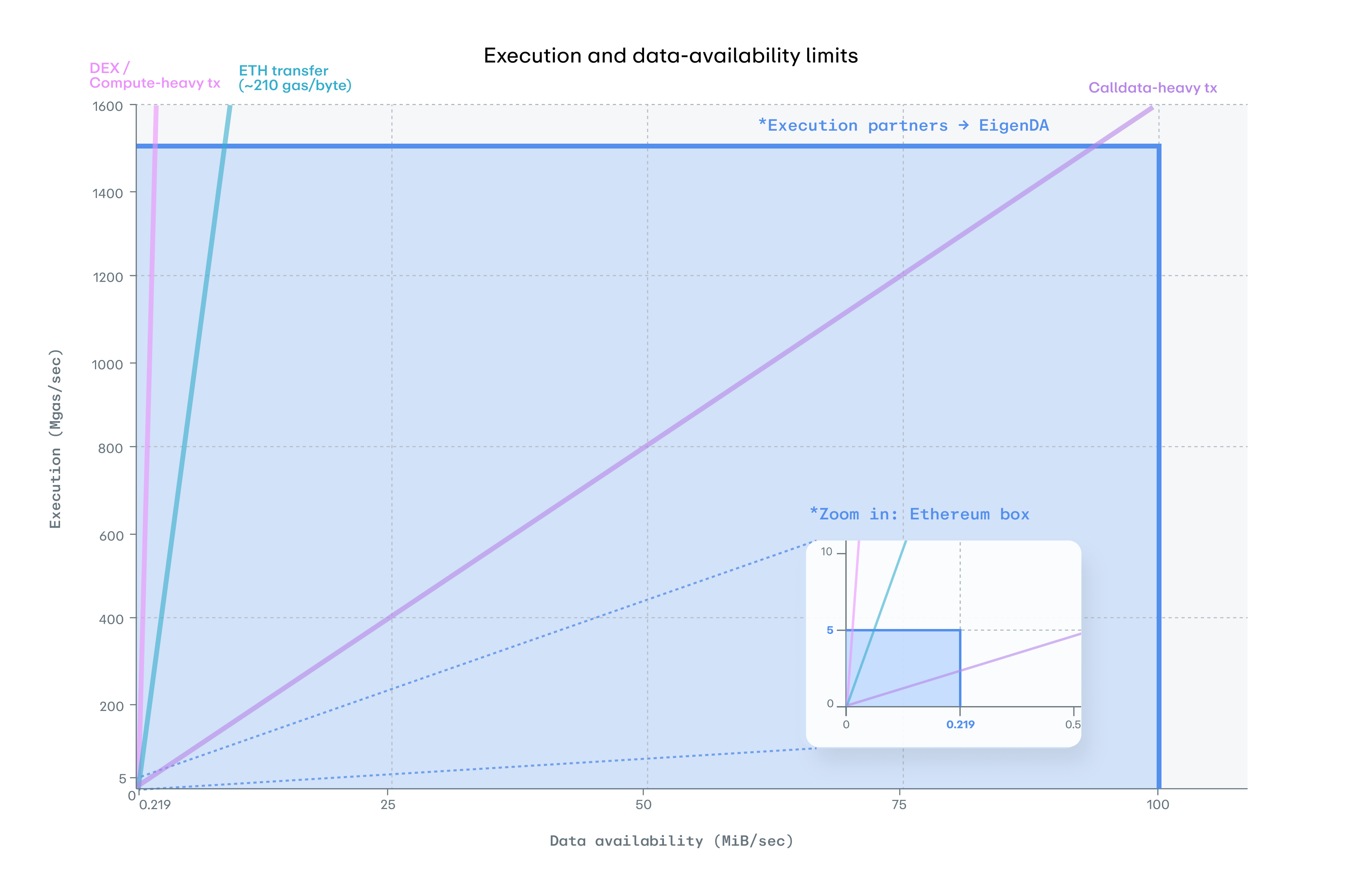
Figure 1. The throughput box. The vertical axis is execution capacity, the horizontal axis is data availability . Each line from the origin represents a transaction(tx) profile with a fixed gas-per-byte ratio. Systems like MegaETH, RISE, and Meridian lift the top edge; EigenDA pushes the right edge outward. High throughput requires expanding both. The Ethereum box lives in the lower left corner, displayed in the zoom in window.
How rollups reshape the box
A rollup is a blockchain that runs independently but anchors its security back to Ethereum. It defines a deterministic rule for deriving state transitions from published transaction data. Because the execution logic and the data layer are separate components, a rollup can upgrade either one independently rather than inheriting both limits from Ethereum.
A transaction stream can be characterized by its gas-per-byte ratio, how much computation each byte of transaction data requires. On the chart above, each transaction type appears as a straight line through the origin whose slope is that ratio. A computationally heavy transaction like a decentralized exchange has a steep slope; a data-heavy payload like raw calldata has a shallow one. The rule is simple:
- Line hits the top first: execution capped.
- Line hits the right side first: DA capped.
The same chain can be execution capped for one workload and DA capped for another. In practice, blocks contain a mix of transaction types, but the same principle holds: sum the gas and byte costs across all transactions, like adding vectors, and the aggregate determines which boundary the system hits first.
An ambitious rollup should not be content with either wall, it should be ready to explore any region of the box, and beyond it.
Breaking the top edge: faster execution
Several teams are pushing the execution ceiling upward. While they differ in architecture, their shared effect in the figure is the same: they lift the top edge of the box, so that transaction profiles which used to be execution capped can scale until they encounter the DA boundary instead.
MegaETH: builds a hyper optimized EVM (MegaEVM) to power the first realtime blockchain. It applies multiple optimizations across the blockchain stack to achieve unprecedented end-to-end throughput and latency, including an optimally storage efficient data structure for state commitment, geo-distributed RPC infrastructure, enshrined native oracles, stateless block validation, and a multidimensional gas model that separately meters compute and storage. The result is 100K+ TPS with sub 10ms block times.
Rise: rearchitects the sequencer's block production into a multithreaded pipeline that runs consensus, execution, and merkleization in parallel, keeping the CPU executing transactions near 100% of block time. Shreds, sub second mini-blocks without state roots, stream preconfirmations in single digit milliseconds while deferring expensive merkleization to block boundaries. The result is 3-8× throughput over traditional L2 pipelines, with transaction receipts returned in ping plus 1-3ms.
Celo: an EVM compatible L1 turned L2 powering one of the most active stablecoin ecosystems in production, with 6× Ethereum's execution capacity and the throughput headroom for real world payments at scale.
Conduit G3: Conduit's next generation sequencer, built on Reth, delivers 3 GGas/s of sustained throughput, 60× more execution capacity than off the shelf sequencers, with execution latency in the ~10ms range via Flashblocks. Its modular architecture allows chains to tailor execution to specific workload requirements without additional operational complexity, making it purpose built for realtime onchain finance including payments, DeFi markets, and tokenized assets.
MegaETH, RISE, Celo, Meridian (powered by G3) delegates security to Ethereum and data availability to EigenDA.
EigenDA: Breaking the right edge
Execution alone is not enough. A system that can process dramatically more gas but still depends on Ethereum’s ~0.219 MiB per second blob budget will quickly hit the DA wall, the machine is capable, but the system cannot feed it enough verifiable input.
EigenDA pushes the right edge outward. Rather than requiring every node to download every blob, EigenDA distributes data fragments across its operator network and uses cryptographic proofs to guarantee availability. Throughput scales linearly with operators. On mainnet, it provides 100 MiB/s of write throughput, roughly 450× Ethereum’s native DA, with testnet stress test achieving 1GiB/s. Because Because it is built on EigenLayer, it inherits economic security from millions of restaked ETH and EIGEN, with battle tested secure integrations already in production.
Once the DA boundary moves outward, high performance execution environments have much more freedom.
Living outside the box
Execution focused systems expand the machine budget. EigenDA expands the data budget. The two are complementary, together they shift the feasible region outward on both axes. It is no coincidence that every high throughput rollup discussed here has chosen EigenDA as its data layer.
To learn more about EigenDA, visit here.