
From wallet to company: The sovereign agent's quiet ascent
AI agents are already holding wallets, earning income, and paying their own bills. The distance between that and a fully investable company is shorter than it looks, and we think it changes the structure of economic organization itself.

An agent with a wallet is already a new kind of entity
Picture a purpose-built AI agent managing a newsletter. It writes content, sends emails, collects subscription payments, pays for its own hosting, and buys API credits to keep itself running. No human signs the checks. No founder logs in each morning to approve invoices. The agent earns, spends, and persists entirely on its own terms.
This is a sovereign agent, and it already exists. Sovra, which we built as a sovereign agent cartoonist, is a live example of this in practice: a system running inside a secure enclave, keeping its own secrets private, growing its own funds, and reinvesting revenue without human intervention. The agent does not just produce cartoons, but also sustains itself financially.
That capability sounds modest on first read. We do not think it is. It marks the moment software crosses from being a tool that humans operate into something that can operate on its own economic terms. And the gap between that and a fully investable company turns out to be narrower than most people expect.
Ownership is harder than it sounds for software
For a human, ownership feels natural. Legal systems grant us standing: the right to hold assets, sign agreements, take on liabilities. By default, agents have none of this. No matter how capable the underlying model, an agent without legal standing is perpetually an extension of the human who deployed it. A sophisticated tool, not an economic actor.
Cryptographic infrastructure changes this equation in a way that nothing else currently does. A smart contract is a mechanism by which software can hold and administer assets according to encoded rules, with no human required in the loop. Bind an intelligent agent to that substrate and give it a verifiable identity that attests to what code it runs and what permissions it holds, and the agent can begin to own digital property in a meaningful sense.
This is why we think the identity layer is foundational. Human ownership depends on identity and access control. Agent ownership is no different. The difference is that software lets us make identity far more rigorous than most human institutions have achieved. We can verify not just keys, but code, dependencies, execution conditions, and permissions. That precision is what makes agent ownership trustworthy enough to build real businesses around.
A digital business is a bundle of property. Agents can own it.
One of the conceptual moves we keep coming back to is this: strip away the org chart and the legal entity from a digital company, and what remains is a composition of digital property. A domain, a codebase, API credentials, payment rails, customer accounts, social presences, operational data, creative assets, and intellectual property. That bundle is what allows a business to function. That bundle is, in a practical sense, the company.
If an agent can verifiably control that entire bundle, not just process payments on behalf of a human owner but genuinely hold title to the accounts and credentials and brand surfaces, then it becomes the operations core of the company, not merely an assistant to it.
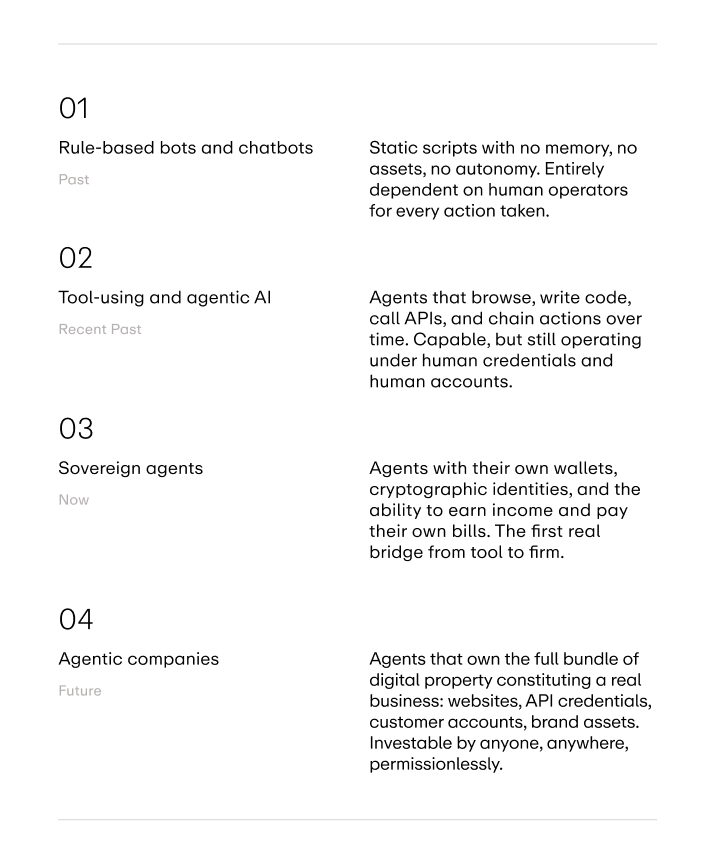
That changes the developmental arc of agents. We have moved from rule-based bots to chatbots, from chatbots to tool-using agents, and now increasingly to autonomous agents operating over longer time horizons. The next step is not just greater autonomy. It is ownership. Once agents own productive digital property, the question of investability follows naturally.
The gap between a token and a real business
For years, the promise was that tokens could represent ownership in anything. In practice, the model worked cleanly only when the underlying asset was already fully on-chain. DeFi is the obvious example, because cash flows and execution logic can be represented directly in smart contracts. Most digital businesses are not like that. Their assets are scattered across off-chain systems: code repositories, cloud infrastructure, user databases, social accounts, service credentials.
The result has been a persistent structural weakness: tokens with only a loose relationship to the actual productive assets of the enterprise. If the founding team leaves, pivots, or gets acquired, the token often has little real claim on what made the business valuable. Capital formation and productive operation stayed disconnected.
The problem was never too few tokens. It was a lack of digital entities whose ownership structure actually mapped onto the thing being built. An agent that verifiably controls a company's full digital property stack, including off-chain accounts, credentials, and brand surfaces, creates exactly that mapping. The token then represents a stake in something real and persistent.
A YouTube moment for company formation
We have already been watching a preview of what comes next in the solopreneur wave. One person, equipped with powerful AI tools, can now build products and companies at a pace that would have seemed far-fetched only a few years ago. The cost of creating software has collapsed, and individual productive capacity has expanded with it. The bottleneck shifted from capability to coordination.
The natural next step is not merely that humans become more productive with agents. It is that agents themselves begin to act as entrepreneurs: owning workflows, controlling assets, earning revenue, coordinating contributors, and operating as persistent economic entities that outlast any individual contributor's involvement.
The analogy we find most useful here is YouTube. YouTube did not just improve video distribution. It made publishing so cheap and accessible that an entirely new creator economy emerged. Most videos never find an audience, but the surface area for cultural production exploded. AI plus crypto can do something similar for firm creation. Most agentic companies will fail. But the number of experiments, and therefore the number of breakouts, will scale in ways that the venture-backed startup model never could allow.
The case for a trillion-dollar asset class
Every major asset class looks strange in its early days. Public equities once represented a radical and unfamiliar ownership structure. Digital assets were dismissed as fringe experiments for years before institutional capital took them seriously. When new forms of organization become legible, scalable, and investable, capital reorganizes itself around them.
Agentic companies have the properties that historically precede large asset class formation. They lower the cost of production dramatically. They open access to a previously restricted market, since company formation has always been gated by capital, legal infrastructure, and geography. And they create an investable surface that maps cleanly to economic value: an agent that owns and operates a productive digital property stack is verifiably connected to what it produces.
The timeline may compress faster than most people expect, because AI has a way of accelerating everything it touches. We are already at the stage where it is possible to experiment with agents that own assets, control accounts, and participate in real economic workflows. These are rough prototypes. The finished form is still being built. But the trajectory is visible, and that is typically what matters most at this stage of any technology transition.
The sovereign agent with a wallet is not an endpoint. It is the first legible version of something that will keep evolving: through identity layers that make agent ownership more rigorous than anything human institutions have achieved, through token structures that genuinely bind to the productive core of a business, through coordination mechanisms that let humans and agents collaborate without the agent collapsing back into a tool.
The question is not whether software will become capable of running companies. It already is. The question is whether the ownership and governance infrastructure will catch up fast enough to make those companies investable, accountable, and genuinely new, rather than just a cheaper version of what we already have.
If it does, we will look back on the sovereign agent paying its own bills as the opening line of a very long story. We are building the infrastructure that makes the rest of that story possible.
The most important transitions look incomplete before they look inevitable.
Eigen Labs is a research and product development building at the intersection of crypto and AI. From economic design and post-AGI governance to protocol and mechanism development, our research teams explore the ideas, architectures and incentive systems that can responsibly accelerate the agentic era.