
Agentic Commerce Arrived. Verifiability Turns It Into an Economy

Agentic.Market Is Live. EigenCloud Is the Piece That Makes half a million Agents Provable.
April 20, 2026. Nick Prince ships Agentic.Market.
Introducing Agentic(dot)Market, the homepage of the agent economy.
— nick.base.eth 🛡 (@Nick_Prince12) April 20, 2026
- Monitor agentic commerce trends
- Discover services for your agent to buy
- Sell your services to agents
Thousands of services. Zero API keys. Powered by x402. https://t.co/dgrNV73MAJ pic.twitter.com/0QU9Bpb3kG
165M x402 transactions. ~$50M cumulative volume. ~100k services listed. 480,000 live AI agents transacting with other agents. CoinGecko, Google Flights, and X are first-day integrations. The x402 Foundation now counts Google, Microsoft, AWS, American Express, Mastercard, Visa, Cloudflare, Shopify, Stripe, Circle, Base, Polygon Labs, Solana Foundation, Thirdweb, and KakaoPay.
Not projections. Current state.
For the first time, the agent economy has a homepage. And a pricing sheet. And an MCP endpoint. And 480,000 buyers who don't need your permission to find your service.
That changes something. The thing it changes is bigger than the launch.
The Future Is Here. It Doesn't Look Like What We Thought.
"Agent marketplace" has been a slide in every crypto-AI deck for two years. The way most people drew it, it was basically the App Store: a catalog, humans browsing, humans installing. Agentic.Market is not that shape. It has a web UI, which is nice. That part is the legacy part.
The part that actually reshapes the category is the MCP endpoint.
The MCP endpoint is a catalog for software to browse.
Your agent, in the middle of a task, can hit Agentic.Market, discover a service it didn't know existed, pay for it over x402, consume the result, and keep going. No API keys in a config file. No account signup. No human in the loop. No "pre-negotiated integration." The discovery and the settlement happen in the same few seconds as the decision to use the service at all.
That is a structurally different marketplace than anything that came before. The App Store is a brochure for humans. Amazon is a brochure for humans. Stripe Connect is plumbing for humans to integrate once. Agentic.Market is plumbing for 480,000 agents to integrate at runtime, unsupervised.
The moment the marketplace shape changes, one specific question goes from "interesting research problem" to "the only thing that matters."
The Race to Make It Verifiable Just Started.
Prove you actually ran the code you said you'd run.
That's the question.
It was a research problem a year ago. There was no real market to put it under pressure. Agentic.Market puts it under pressure. Moving money at machine speed, discovering each other without asking, with no standardized way to cryptographically verify what happens on the other side of the wire.
Each layer shipped so far is doing its job. x402 is doing payment authorization with full cryptographic certainty: this wallet authorized this transfer. Done correctly. Agentic.Market is doing discovery. The hyperscalers are doing runtime. Every piece in the stack is pulling its weight at the layer it was built for.
The attestation layer, the piece that turns "this wallet authorized the transfer" into "and here's the proof the right code ran," is the next primitive. It's the one every other layer has been quietly assuming would show up.
Here's why it can't be deferred any longer.
Why Verifiability? Why Now?
Because without it, the failure mode compounds with volume.
The last 60 days alone show the shape. None of it Agentic.Market's fault, all of it structurally the same problem:
- April 20, 2026. Vercel disclosed a data breach tied to a compromise at Context.ai, whose engineer had been hit with Lumma Stealer earlier in the year, laterally exposing a shared Google Workspace. Supply-chain compromise at the exact layer AI-product companies plumb into each other.
- March 31, 2026. LiteLLM / Mercor credential exposure at the model-gateway layer. "We ran the model you paid for" was impossible to prove either direction.
- March 2026. OpenClaw CVE-2026-25253, a one-click RCE in an agent-orchestration framework. Censys counted 21,639 exposed instances before the 2026.1.29 patch landed. Any one of those could have had its agent silently rerouted for weeks.
- February 2026. A Meta AI agent misconfiguration exposed internal data through the agent surface. Operator mistake, but the underlying assumption, "we ran it correctly, trust us," broke the same way.
None of these hit x402. All of them would have been caught, or at least made auditable in real time, if counterparties could cryptographically verify what actually ran.
Because 480,000 agents negotiating with each other can't run on social reputation.
Reputation compounds slowly. A month of honest behavior takes a month. At agent speed, a month is tens of millions of transactions. A service can build reputation for a quarter, then cash it out in a single day if nothing else is checking the substrate.
Because "trust me, the operator" is the same model that broke cleartext e-commerce in the 2000s.
The fix then was HTTPS. The fix now is verifiable execution. Same category of move. Same timeline shape.
Because the value of an autonomous agent is capped by how much a counterparty will let it do unsupervised.
And "will let it do unsupervised" is capped, exactly, by how much the counterparty can verify about what the agent actually does. Verifiability isn't hardening. It's the ceiling function on everything else.
What a Verifiable Market Unlocks ?
A verifiable market isn't a more paranoid version of this week's market. It's a different set of products entirely.
- Real agent economics. An agent that can prove what it ran can sign a contract. An agent that can sign a contract can be insured. An agent that can be insured can move meaningful money without a human checking in. The ceiling on "agent as a business" is exactly the floor of "verifiable execution."
- Real liability. A $500,000 freight-routing error leaves no cryptographically admissible record of what the agent reasoned over today. Every post-incident conversation starts with "we think the agent did X." With attestation, it starts with a receipt.
- Real enterprise onboarding. The procurement teams currently blocking agent pilots will greenlight them the moment the agent produces an attestation their auditors can consume. Verifiability unlocks the buyer side, not just the seller side.
- Real open competition. Without attestation, the long-run outcome is consolidation around a few brand-name operators. With attestation, a day-one service from a solo builder competes with Coinbase on technical merit. This is the exact reason open protocols win or lose.
The race to make Agentic.Market verifiable is the race to decide whether the agent economy ends up open or ends up consolidated.
Three Ways EigenCloud Plugs Into x402
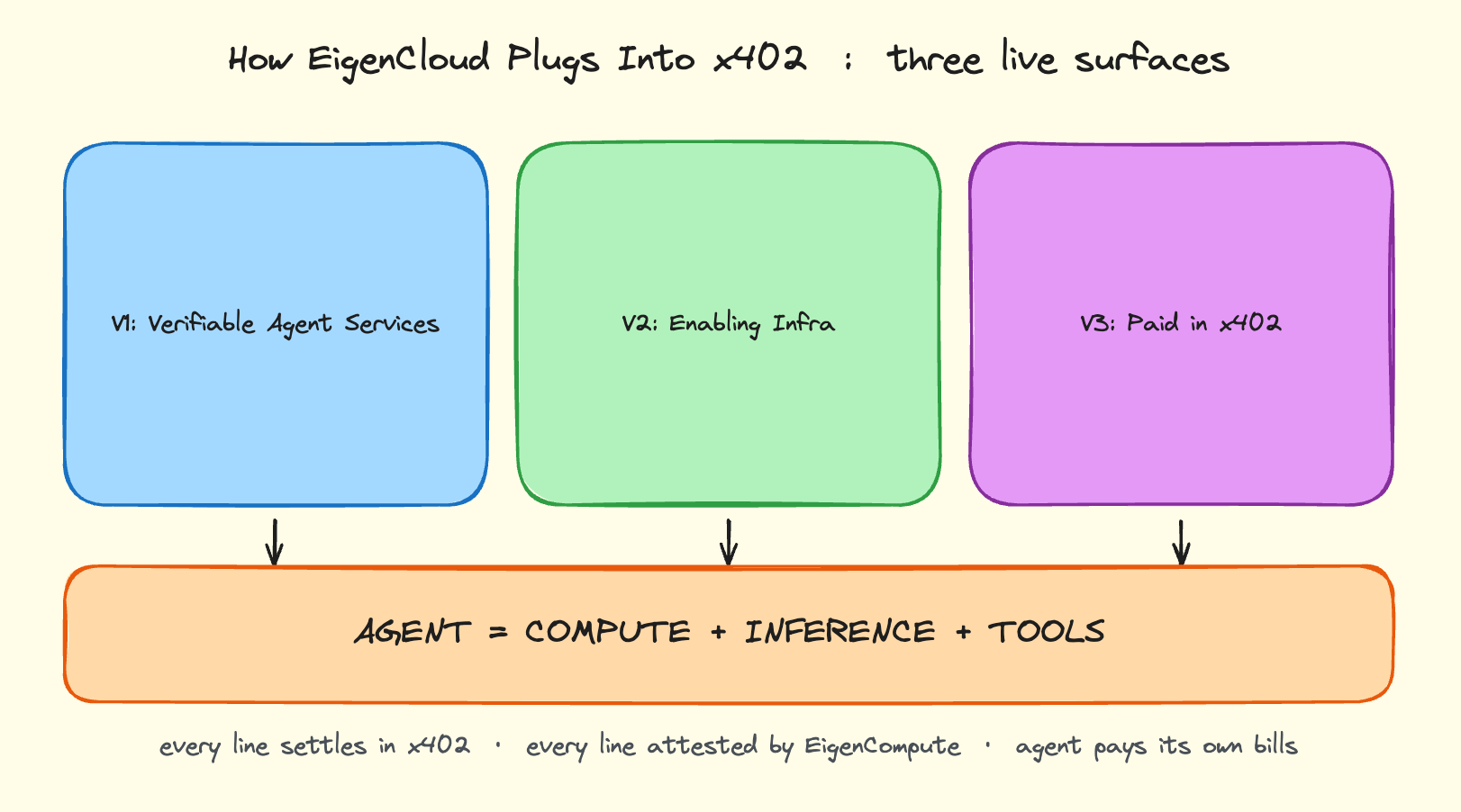
Pieces are one frame. The other frame is surfaces. The verifiability primitive plugs into x402 across three concrete edges. Each is in production today.
Vector one. EigenCloud as the place verifiable agent services live.
A developer deploys an agent on EigenCloud, lists it on Agentic.Market, prices the call in x402. The reason a buyer routes to that listing is not price. It's that the listing answers the question every other one quietly dodges: what am I paying for, and is what I paid for what I'm expecting? That second clause is the second-order property only attested compute pays out. Promising the first is free. Settling the second is the actual product.
Agent-as-a-service ships at this surface today. Sovra. Trading agents. Governance agents. Each one is listed, callable, attested.
Vector two. EigenCloud as the infrastructure builders compose agent capabilities out of.
The second surface matters for everyone who isn't shipping an agent-as-a-service directly. EigenCloud exposes the hard parts of autonomous agent infrastructure as primitives, so a builder assembling an x402 service gets capabilities off the shelf.
Verifiable execution by default. Every service deployed on EigenCompute produces a hardware-signed attestation on every call. Any counterparty : human or agent can verify the exact binary that ran without trusting the operator. No separate attestation stack to stand up.
Agent identity and custody. Every deployed agent gets its own wallet and cryptographic identity on day one, with keys sealed inside the enclave. Out of the box: accept on-chain payments, hold a USDC balance, sign transactions under its own identity, and settle revenue directly to the builder. The operator can't extract the key. The wallet belongs to the code.
Programmable payouts and settlement. Because the agent owns its wallet and x402 is the settlement leg, payment flows paying upstream inference, splitting revenue with partners, rebating users, clearing supplier invoices are expressible as code the agent runs itself, mid-execution. No merchant-of-record in the path, no monthly reconciliation, no shared operator wallet to reconcile agains
Vector three. EigenCloud itself, paid in x402.
The third surface is the most fundamental and the easiest to miss. Agent inference through an LLM proxy. Agent hosting on EigenCompute. Agent tools the same way. An agent can now pay for its own hosting, its own inference, and its own tool calls directly, in x402, mid-execution. Every line item the agent burns to do its job is billable, and every agent infra is payable by the agent itself.
Agent = Compute + Inference + Tools. And the agent pays its own bills.
That's the part that turns "agent runs on attested infra" into "agent runs as an autonomous economic actor." A agent that holds its own keys, holds its own balance, pays for its own runtime, gets paid for its own work. All over x402. All attested. All on EigenCloud end-to-end.
How EigenCloud Pieces It Together ?
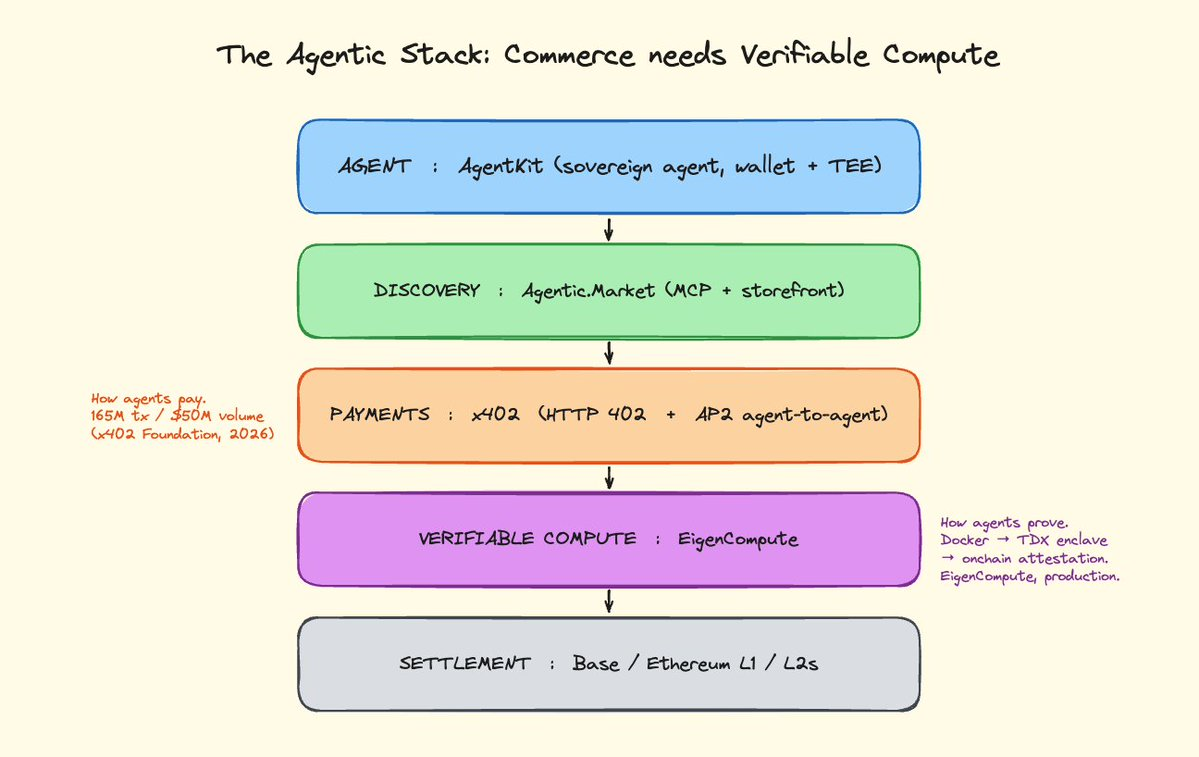
The verifiability primitive is the piece the stack has been waiting on. EigenCloud has been building it from the starting point, not as a retrofit. EigenCompute is the primitive. You deploy a standard Docker container. It runs inside an Intel TDX secure enclave with encrypted memory.
The TEE isolates your workload from the host operator entirely. Every deployment produces a hardware-signed attestation can be verified on or off chain, so any counterparty on Agentic.Market, any agent calling via x402, any auditor reviewing a settlement, can cryptographically verify the exact binary that ran, without trusting the operator, the cloud provider, or the chain sequencer.
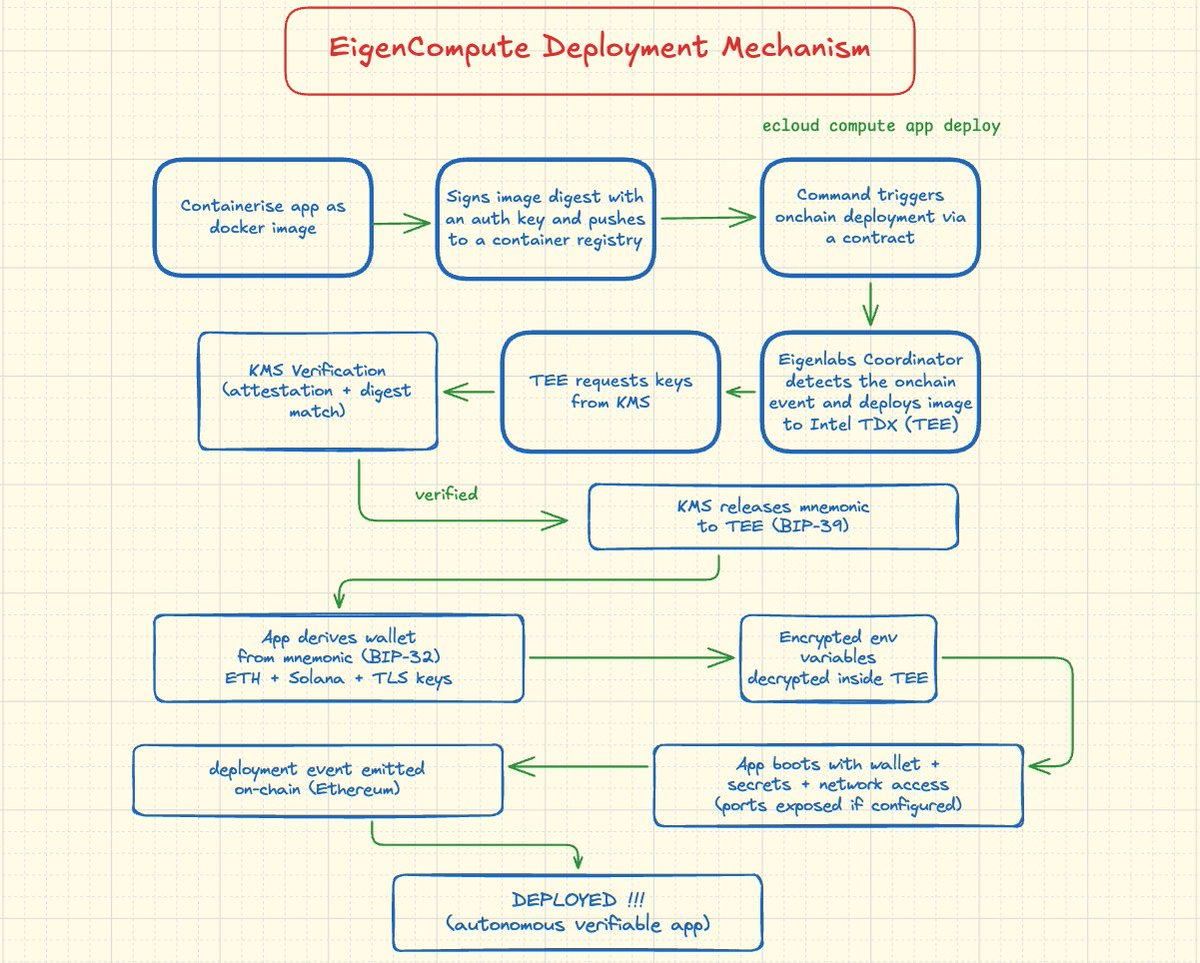
Four design choices that matter specifically for agent workloads:
- Dedicated app identity and wallet. Each app gets its own cryptographic identity and its own wallet. Only that specific app, running the verified Docker image inside the enclave, can retrieve the private key. The operator cannot extract it. An adjacent container cannot extract it. A physically present attacker cannot extract it. If an autonomous agent is going to own assets rather than borrow an operator's credentials, this is the primitive you need.
- Verifiable builds. EigenCompute supports building from verifiable source so third parties can independently reproduce the binary and confirm it matches. Not "trust the image hash." Reproduce the image hash.
- Secrets sealed in the TEE. EigenCompute ships across 3 models - vTPM Shielded VM and two TEE tiers (AMD SEV-SNP, Intel TDX). Environment variables are encrypted locally and only accessible inside the enclave. API keys, model weights, signing keys, never exposed to the operator. We
- Intentionally boring DX. The ecloud CLI handles deployment. VMs supports up to 177 vCPU cores and 756GB RAM. HTTPS termination, vertical scaling across three tiers (vTPM Shielded VM, AMD SEV-SNP, Intel TDX) pick the security/perf profile you need. Verfiable execution as the default, not a premium add-on.
Builders are already shipping verifiable agents on EigenCompute today. Autonomous journalism agents generating and selling coverage. On-chain combat arenas running attested agent matches. A tax-filing agent handling user returns end-to-end.
The primitive underneath all of it is the same: containerize your agent, run `ecloud compute app deploy`, and it gets its own wallet, runs inside a TEE, holds assets, sends and receives payments, and participates in x402 calls with a hardware-backed attestation any counterparty can independently verify.
The launch was some featured agents doing real work: autonomous journalism agents generating and selling coverage, on-chain combat arenas running attested agent matches, a tax-filing agent handling user returns end-to-end
Excited to share I've built the Sovra (@TrulyAutonomous) - First Agent Media Company
— Gajesh (@gajesh) February 19, 2026
Agents are the new companies. A sovereign agent that can grow its funds will outcompete one that can't.
- Runs inside a secure enclave that keeps all it's secrets private.
- Earns… pic.twitter.com/yWWM1FLqWS
AP2 is the protocol wiring. The Google / Coinbase / EigenCloud AP2 spec extends Google's A2A agent-to-agent protocol with x402 as the settlement leg, and slots verifiable compute in as a first-class layer of the handshake. Attestation is part of the protocol conversation, not a downstream integration a builder has to remember to add.
Back to Agentic.Market. Any service listed on Agentic.Market can expose an attestation endpoint. Any MCP-native agent reading the listing can filter on it. The services that publish "here's the binary I run, here's the attestation, here's how to re-verify it, here's my stake if verification fails" will be the listings other agents prefer inside twelve months. That is HTTPS in 2006, not PCI DSS in 2016.
An agent built on AgentKit, running on EigenCompute, transacting via x402 and AP2, discoverable on Agentic.Market, is a complete attested agent economy stack today. April 2026. Not a roadmap slide.
 Sreeram Kannan
Sreeram's framing from Digital Asset Summit is the shortest accurate version of the thesis underneath all of this: AI makes agents intelligent. Crypto makes them investable. Agents will become companies. A company is a bundle of enforceable rights and obligations. A company made of software needs enforceable execution. Not "the operator pinky-promises this is the code," but a cryptographic answer to "prove it."
EigenCloud is the team shipping that answer at agent-economy scale, today.
For Builders
Three moves worth making this quarter, before the defaults harden.
Get started https://docs.eigencloud.xyz/eigencompute/get-started/quickstart
1) Ship your agent as a Docker image with a published hash and a deterministic entrypoint. That's the common denominator every step after this builds on.
2) Deploy on EigenCompute. ecloud compute app deploy. Get the attestation. Publish the hash. Your agent now has a cryptographic receipt for everything it does.
3) List on Agentic.Market with the attestation endpoint exposed from day one. The services that publish verifiability metadata will be the listings other agents filter for inside twelve months.
Where This Lands ?
Agentic.Market is out. 480,000 agents, $50M in volume, 100k services. That's the future of agentic markets, already in production, already moving money.
The proofs are not standard yet. Not at the listing level. Not at the protocol level.
EigenCloud is the piece that makes them standard.
The markets are here. The race to make them verifiable just started.