
A verifiable cloud for the agentic era
As agents touch real value, provenance and proof matter more than raw performance. EigenCloud is the verifiable cloud for the agentic era.

By JT Rose
A new agentic era is here. As this new economy takes shape, the systems we’ve built to coordinate with one another will be pushed to the limit. If we want to offload more complex and important work to agents, we must ensure they are built on trusted infrastructure so they can be held to account for the decisions they make and the actions they take.
For the last five years, our mission at Eigen Labs has been to build humanity’s coordination engine for open innovation. We’ve shipped protocols and products that allow application builders to bootstrap trust and make credible commitments to their users, at internet scale.
Along the way, it became apparent that the coordination problem of our time would not be human coordination but humanity’s coordination with agents. We built EigenCloud with this coordination problem in mind.
At the time, it felt over-engineered. Agents were not nearly as powerful as they are today. But that’s changed dramatically the past few months. Agents are rapidly becoming economic actors: systems that can observe, decide, transact, and execute. The stewards of global financial rails, from Visa and Stripe to PayPal and BlackRock are hastening the transition from internet commerce to agentic commerce. But as we offload more critical tasks to agents and as agents touch real value - things like money, reputation, private data or sensitive IP - the question of trust becomes paramount. Provenance and proof will be much more important than raw performance.
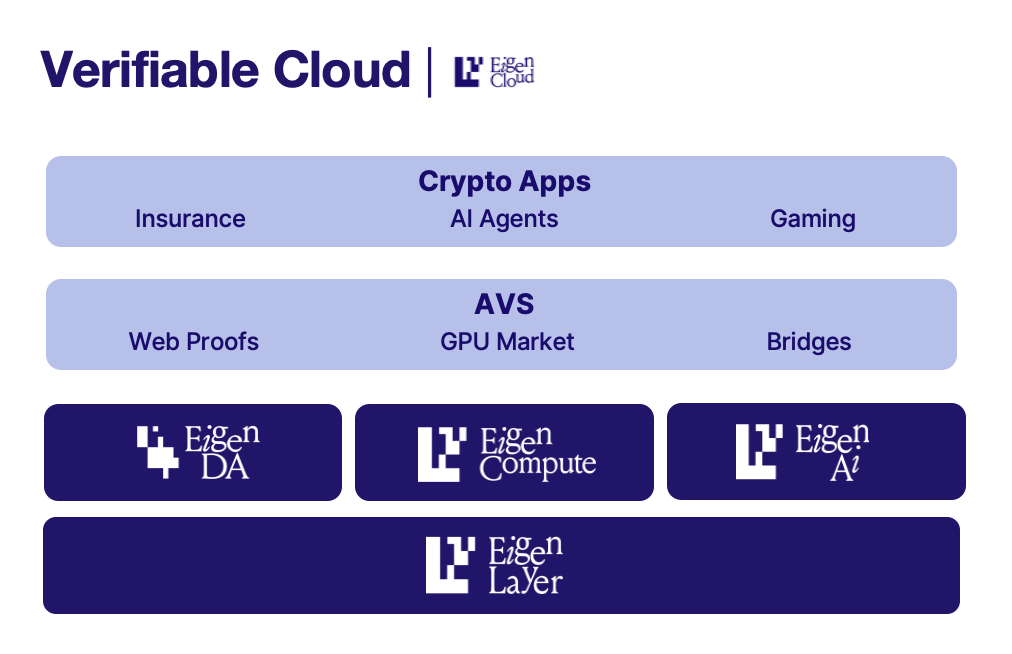
That’s the frame we’ve been exploring with our product teams and investors. Entering 2026, there are five questions that sit at the intersection of agents and verifiable infrastructure that EigenCloud is uniquely positioned to answer.Before the questions, a quick grounding in what’s now true. In 2025, we finished building a world-class infrastructure foundation:
- EigenLayer became protocol-complete with slashing and redistribution—fulfilling the core promise of the original design.
- EigenDA pushed throughput milestones on testnet—showing that verifiable data availability can live in the “internet scale” regime.
- EigenCompute reached an AWS-like developer experience, but with crypto-grade trust: deploy apps, games, or agents like cloud software, with onchain verifiability and smart-contract bindings.
- EigenAI pioneered deterministic, verifiable inference for open-source models, offering an early glimpse of what it means to treat AI execution as something you can audit, not just interpret.
These primitives are not just theoretical, we’re already seeing early integrations and design partnerships with leading teams across cloud and crypto like Google and Coinbase, helping shape how verifiable compute and agentic systems get deployed in the real world.Some people look at that and say “Eigen is pivoting.” I see the opposite. These are not random products; they’re the foundational Lego pieces required to build internet-scale systems on crypto rails. AWS didn’t “pivot” when it shipped S3, EC2, and managed databases. It laid primitives that made an entirely new application universe possible. EigenCloud is doing the same thing for a world where trust is a first-class requirement. This year we’ll start using them to build trusted apps and agents ourselves.
Now, the five questions.
1) What trust models let agents take higher-stakes actions?
Until recently, most agents and LLMs were powerful, but mostly one dimensional tools. We’ve used them with a mix of awe and skepticism: you prompt them, they respond, you set them to “dangerous-skip-permissions”, they act and you hope the chain of decisions executes the way you intended. That trust relationship works for low-stakes tasks, but it breaks immediately when the agent is trading, routing payments, updating production systems, or coordinating with other agents.The trust model we need isn’t “I trust this because I trust OpenAI (or whoever built the model).” The last ten years of broken promises by large tech companies should have made this obvious. The trust model we need is one of verifiability and accountability. It is the reason open source models and local agents are taking off. We should aspire to a different trust model, one where we can trust what data and weights were used, can audit the computation that was performed, and trust the inferences that were made. A model where agents can be held accountable for their outputs and actions.EigenLayer democratized crypto’s best tool for accountability (slashing). EigenCloud extends that tool to apps and agents: you can bind an agent’s offchain behavior to onchain enforcement. If you’ve heard Soubhik Deb talk about this, you know the punchline: trust is not a UI feature; it’s infrastructure. This is something we are currently exploring with agent builders.
2) What does it take to level the playing field between agents and humans?
Humans can own property, sign contracts, open accounts, and be held liable. Agents cannot. That’s not a philosophical limitation; it’s simply missing infrastructure.We’re seeing early foundations being built on Ethereum with x402 and ERC-8004: agents discovering one another, paying each other and forming workflows together. But payments are not the endgame. The deeper question is whether agents can be persistent actors with state, rights, and obligations. EigenCompute is designed around this: agents that can run continuously, interact with financial rails, and have their offchain activity verified and encumbered by smart contracts
3) If agents are first-class actors, can they run companies?
At some point, “an agent” stops looking like a tool and starts looking like an organization: a coordinated system handling customer interaction, operations, procurement, treasury, growth, compliance and execution loops.What sounded far-fetched six months ago is now being baked into market prices. The cost of building software is collapsing and SaaS valuations are plummeting.As companies become less about writing code and more about managing commitments (who does what, under what constraints, with what enforcement) coordination becomes an important bottleneck.It’s our belief that a fully agentic commerce system - where you can buy from, sell to, invest in, borrow from, and hire agents - should be built with verifiable compute (EigenCloud) and insured by robust offchain smart contracts and slashable stake (EigenLayer). There will be more primitives required in time. This is guiding our roadmap.
4) What happens when capitalization and coordination get collapsed too?
As AI collapses the cost of product development, the next bottlenecks to forming and growing a company are capitalization and coordination. These are two problems that tokens are uniquely suited to address.As the US crypto market structure bill shifts the overton window of acceptable token use cases, the design space for compliant, programmable finance is about to be blown open. Many of our peers see the same opportunity. The question we have is, as markets develop a more nuanced appreciation for tokens, what does it look like to tokenize an agentic company? Can you make ownership, incentives, revenue share, and governance composable by default?
5) What does a fully self-running idea look like and what should we optimize for as a society?
If we squint, we can see companies that form and operate fully autonomously. Where ideas are not funded by VCs, but spoken into existence in natural language and seeded to achieve an objective function. Like Bitcoin, they can adapt organically, recruit contributors, coordinate incentives, and evolve beyond any fixed human team. The agentic era may well give us another chance to build permissionless, DAO-like companies. But how can you launch, fund and sustain companies with no founder and no fixed team?As agents remake the internet and our relationship with work along with it, an important goal for humanity will be democratizing participation in the AI economy. If we get the infrastructure right, agents won’t just reshape our work; they can also unlock new forms of open innovation.
EigenCloud is built for that world: a verifiable cloud for the agentic era.
More to come.
Originally published here. Cross-posted by the author.